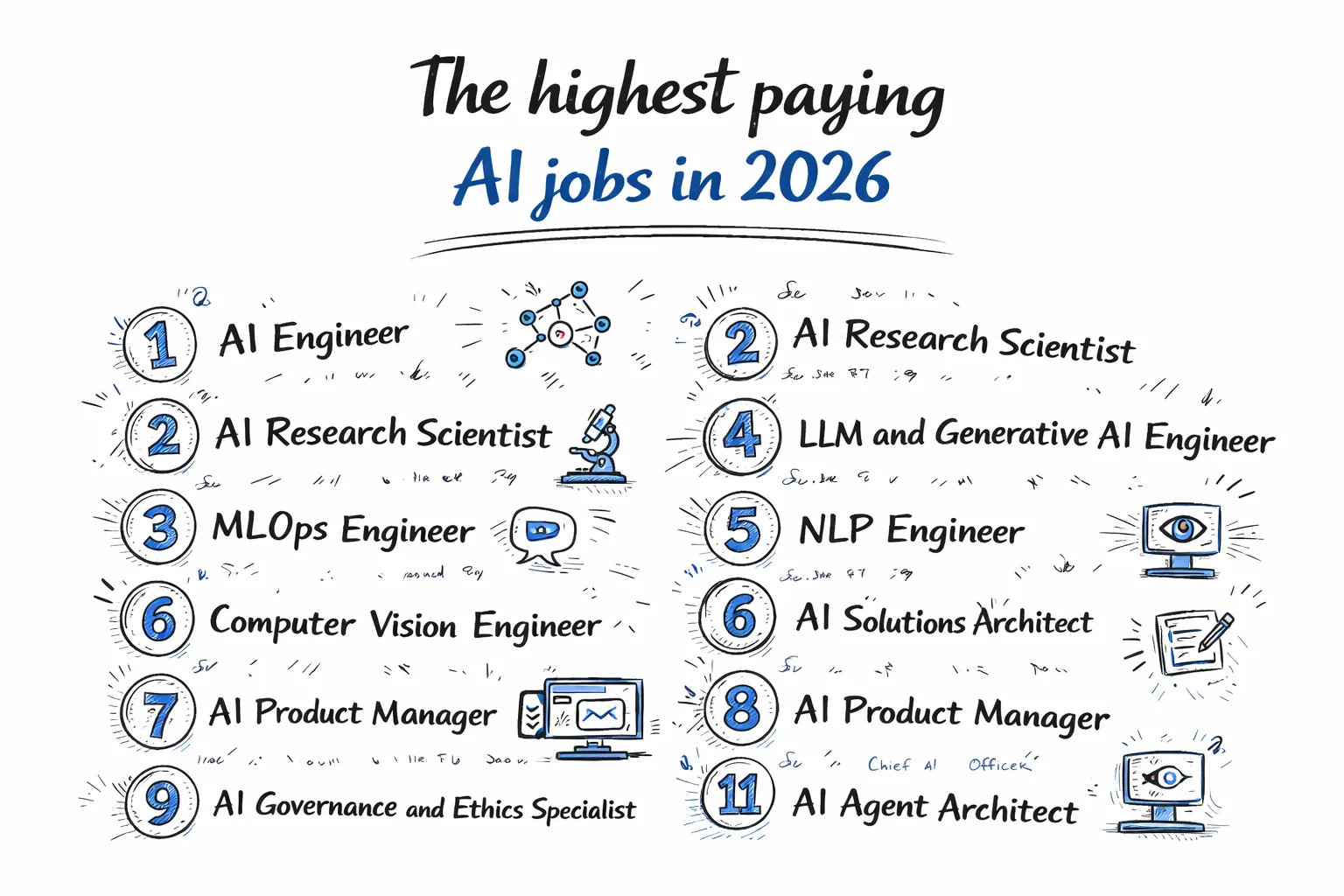
27 AI Jobs Paying Over $100,000 in 2026: Salaries, Skills, Career Paths, and Hiring Trends
Executive Summary
Artificial intelligence has become one of the most important economic forces of the decade. Organizations are investing in generative AI, machine learning, automation, analytics, and intelligent decision-support systems. As adoption accelerates, demand for skilled professionals continues to exceed supply. This guide explores high-paying AI careers, required skills, salary expectations, and opportunities across industries.
Why AI Jobs Are Growing
Businesses face pressure to improve productivity, reduce costs, and deliver better customer experiences. AI helps organizations automate repetitive work, analyze large datasets, forecast trends, personalize customer interactions, and improve operational efficiency. As a result, AI-related hiring is expanding across healthcare, finance, cybersecurity, manufacturing, retail, logistics, education, and marketing.
Salary Landscape
| Role | Average Salary |
|---|---|
| AI Solutions Architect | $150,000-$300,000+ |
| Machine Learning Engineer | $140,000-$280,000 |
| AI Product Manager | $120,000-$250,000 |
| AI Consultant | $100,000-$300,000+ |
| Prompt Engineer | $90,000-$180,000 |
The 27 AI Careers
1. AI Solutions Architect
Designs enterprise AI systems, selects technology stacks, evaluates vendors, and oversees implementation strategies. This role combines technical depth with strategic business thinking.
2. Machine Learning Engineer
Builds, trains, deploys, and monitors machine learning models used in production environments.
3. AI Product Manager
Bridges the gap between technical teams and business stakeholders.
4. AI Consultant
Advises organizations on AI adoption, transformation initiatives, and ROI measurement.
5. Prompt Engineer
Develops prompts, workflows, and evaluation systems for generative AI platforms.
6. AI Research Scientist
Conducts advanced research and algorithm development.
7. Data Scientist
Uses statistics, analytics, and machine learning to generate insights.
8. NLP Engineer
Builds language-based AI systems including chatbots and search tools.
9. Computer Vision Engineer
Creates systems that understand images and video.
10. Robotics Engineer
Develops intelligent robotic systems.
11. AI Security Specialist
Protects AI systems and data from misuse.
12. Deep Learning Engineer
Works with neural networks and advanced architectures.
13. AI Operations Manager
Oversees deployment, governance, and optimization.
14. AI Business Strategist
Aligns AI projects with business objectives.
15. AI Governance Specialist
Focuses on ethics, compliance, and risk management.
16. AI Auditor
Evaluates performance and compliance of AI systems.
17. AI Integration Specialist
Connects AI solutions with existing business systems.
18. AI Marketing Strategist
Uses AI to improve campaigns, personalization, and customer acquisition.
19. AI Sales Engineer
Supports enterprise sales of AI products and services.
20. AI Knowledge Manager
Organizes organizational knowledge for AI utilization.
21. Generative AI Specialist
Designs workflows powered by large language models.
22. AI Trainer
Improves AI outputs through evaluation and feedback.
23. AI Analyst
Analyzes AI performance and business impact.
24. AI Program Manager
Coordinates large-scale AI initiatives.
25. AI Customer Experience Lead
Improves customer journeys using AI.
26. AI Automation Architect
Designs end-to-end automation systems.
27. Chief AI Officer
Leads enterprise AI strategy and transformation.
AI Jobs Without Coding
Not every AI role requires software development expertise. Product managers, consultants, strategists, trainers, recruiters, sales engineers, and operations managers often focus on business outcomes rather than coding.
Skills Employers Want
- Prompt Engineering
- Python Fundamentals
- Data Analytics
- Machine Learning Concepts
- Communication
- Strategic Thinking
- Project Management
- Problem Solving
Industries Hiring AI Talent
Healthcare, finance, cybersecurity, retail, logistics, manufacturing, insurance, education, and marketing continue to invest heavily in AI initiatives.
How to Start an AI Career
Learn the fundamentals, build projects, create a portfolio, document results, and demonstrate measurable business outcomes. Employers increasingly value practical experience and evidence of execution.
Frequently Asked Questions
Is AI a good career?
Yes. AI remains one of the fastest-growing professional fields.
Can I work in AI without a degree?
Yes. Skills, projects, and results often matter more than credentials.
Which AI jobs pay the most?
Chief AI Officer, AI Solutions Architect, and AI Research Scientist roles typically command the highest compensation.
Conclusion
Artificial intelligence is creating opportunities across technical and non-technical disciplines. Professionals who continue learning and adapting will be well positioned to benefit from one of the largest workforce transformations in modern history.